Medical Practice Management: How to Optimize Appointments, Reduce Absences, and Save Time

Managing a medical clinic today involves much more than patient care. For many doctors and administrators, the real challenge lies outside the examination room: disorganized schedules, patient no-shows, overwhelmed staff, and a constant flood of incoming WhatsApp messages.
Effective medical practice management has become a critical factor for both profitability and the patient experience. However, a large percentage of private clinics continue to operate with manual processes that consume time, generate errors, and cause silent financial losses month after month.
In this article, we analyze how to optimize medical appointment management in private clinics. We provide concrete data, real-world examples, and practical solutions that modern clinics are already using to reduce absences, save administrative time, and regain control of their schedules.
The Pillars of Efficient Clinic Administration
To talk about successful clinic administration, we must understand that the core of the business is not just the medical diagnosis, but the operational flow that allows that diagnosis to happen.
Clinic Administration: Beyond Medical Records
Many healthcare professionals confuse medical office management with simply filling out medical histories. However, comprehensive healthcare practice management covers everything from the patient's first contact (marketing and acquisition) to post-consultation follow-up.
Poor front-desk management is often the leading cause of lost revenue, even if the physician is the best in their specialty. Clinic administration determines whether the daily routine flows smoothly or turns into chaos. It includes vital processes such as:
-
Appointment scheduling
-
Confirmations and reminders
-
Patient management
-
Communication and follow-up
-
Medical calendar control
When these processes are not optimized, the impact is direct: more stress, lower productivity, and decreased revenue.
Key Differences Between Traditional and Digital Practice Management
The traditional model relies on a physical notebook or, at best, an Excel spreadsheet that only one person knows how to manage. This creates dependency and human error. Modern medical office management utilizes the cloud to ensure information is accessible, secure, and, most importantly, actionable.
The Importance of Patient Management in High-Demand Clinics
As your clinic grows, patient management becomes more complex. It is no longer enough to remember names; you need to know attendance histories, contact preferences, and cancellation behaviors. Data is the best ally for profitability.
Common Challenges in Medical Office Management
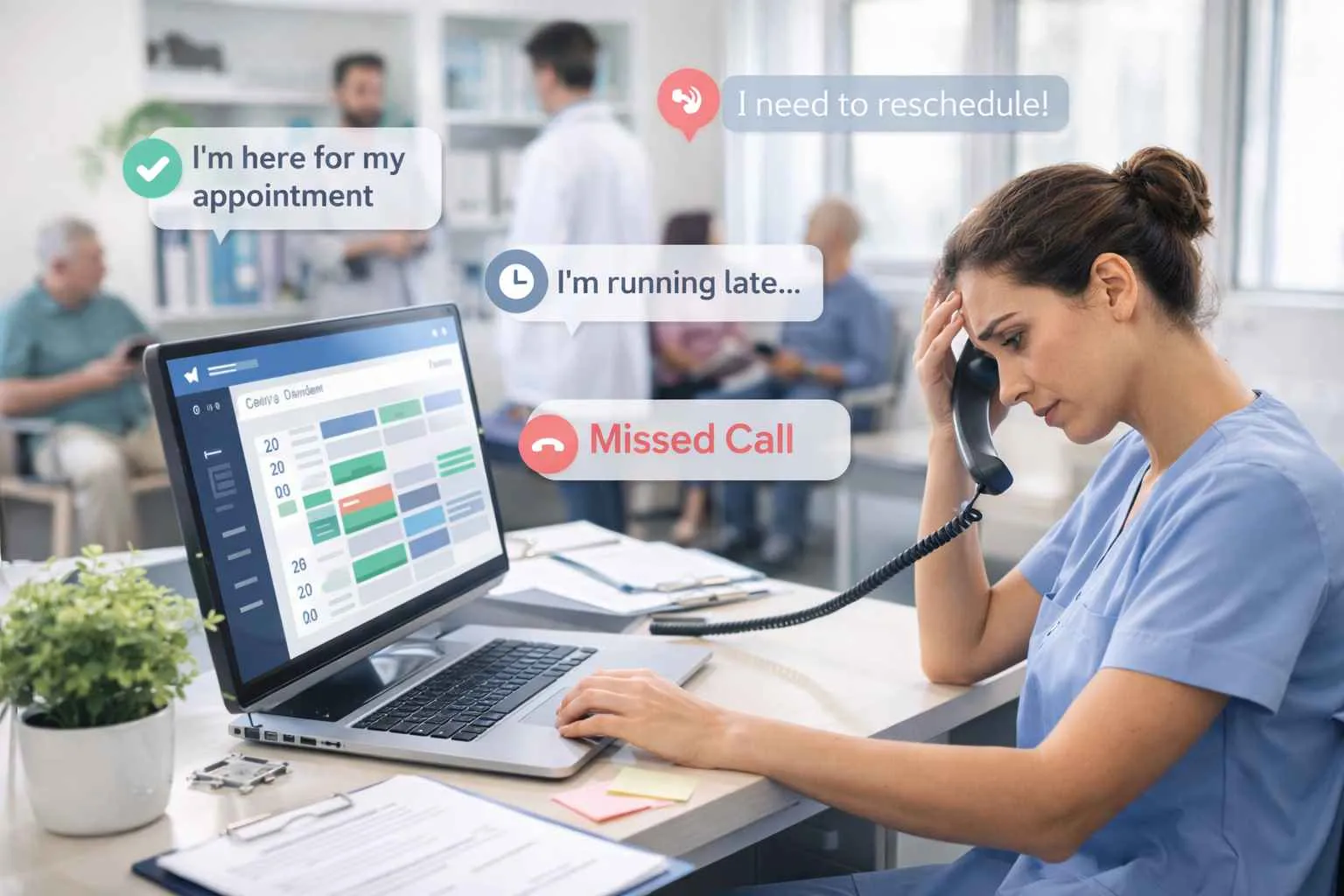
Identifying problems is the first step toward solving them. In our experience working with hundreds of professionals, these are the most common "pain points" in medical practice management:
1. The Manual Scheduling Bottleneck
If your team spends 4 minutes on every appointment scheduled via phone or manual chat and manages 50 appointments a day, they are losing over 3 hours daily on a task that provides no clinical value. In many private clinics, administrative staff dedicate 30% to 40% of their day solely to appointment-related tasks:
-
Responding to WhatsApp messages
-
Answering calls
-
Manually confirming, cancelling, or rescheduling
This not only raises operating costs but also increases the risk of human error and decreases patient satisfaction.
2. The "Traditional WhatsApp" Trap
WhatsApp is the patients' preferred channel, but using it manually is a productivity trap. Managing bookings without an automated process or sending reminders one by one is a massive time drain. Using WhatsApp for medical clinics effectively requires automation to free up your team for higher-value tasks.
3. The Financial Impact of Patient No-Shows
A patient who doesn’t show up represents an hour of consultation time, electricity, staff, and medical equipment wasted that cannot be recovered. Healthcare industry studies show that clinics lose between 5% and 15% of their monthly income due to unplanned absences. Learning how to reduce medical no-shows is, literally, putting money directly back into your pocket.
Example:
-
Clinic with 20 daily appointments
-
Average Ticket: $60
-
No-show rate: 15%
-
Monthly Loss: Over $3,600 in unbilled consultations.
-
Annual Loss: Exceeds $40,000.
Most of these absences are avoidable if you rely on practice management software with automated reminders or pre-payment systems.
Strategies: How to Optimize Medical Appointment Management

If you are wondering how to optimize scheduling, the answer is simple: eliminate friction.
Centralizing Communication
Patients don’t want to call; they want to text. But for the clinic, receiving messages across Instagram, Facebook, WhatsApp, and phone calls is chaotic. The solution is to centralize everything into a platform that allows for fluid, multi-channel medical appointment management.
24/7 Online Booking Implementation
A high percentage of patients try to book appointments outside of office hours. If your clinic only responds from 9:00 AM to 6:00 PM, you are losing patients. An online booking link allows your clinic to "sell" its services while you sleep.
The Use of Automated Appointment Reminders
Forgetfulness is the number one cause of no-shows. Implementing automated appointment reminders via WhatsApp—where patients actually read them—drastically increases confirmation rates. WhatsApp has open rates exceeding 90%, far above email or SMS. It’s not just about notifying the patient; it’s about giving them the option to "Confirm" or "Reschedule" with a single click.
Practice Management Software and Automation: Why Technology is No Longer Optional
Technology is no longer a luxury; it is a basic necessity. Modern clinic scheduling software must offer:
-
Accessibility: It must be usable from both web and mobile.
-
Automation: If the software doesn't save you manual work, it’s just another administrative chore.
-
Security: Protecting health data is critical under regulations like HIPAA or GDPR.
From Manual Management to Total Autonomy with Happoin
This is where Happoin comes in—a platform specifically designed to solve scheduling chaos. Unlike complex, legacy systems, Happoin turns your business WhatsApp into an intelligent assistant.
-
HappiBot: Your New Right Hand. An AI-powered bot that doesn't just say "hello"—it shows your availability, books the appointment, collects patient data, and registers it in your calendar automatically.
-
Real No-Show Reduction. With Happoin, reminders are sent from your clinic’s WhatsApp number. This builds trust and professional closeness, reducing no-shows immediately.
-
Customizable Medical Records. Beyond scheduling, Happoin provides customizable electronic health records that adapt to your specialists' needs, centralizing all management in one place.
-
Total Control. While the bot works for you, you remain in control through a statistics dashboard, viewing business performance and projected income.
Step-by-Step: Digitalizing Your Clinic Today
-
Audit Your Time: For one week, measure how much time your team spends manually scheduling and confirming appointments.
-
Choose Your Tool: Look for practice management software that integrates with the tools your patients already use, like WhatsApp.
-
Set Your Services and Schedules: Clearly define what you offer and leave "buffer spaces" between appointments.
-
Communicate the Change: Invite your patients to use your new booking link. Highlight the convenience of booking in seconds.
7. Frequently Asked Questions (FAQ)
What is medical practice management and why is it vital for profitability? It is the set of administrative and operational processes that allow a health center to function. Efficient management maximizes medical time, reduces costs, and improves patient retention.
How can I optimize medical appointment management easily? The most effective way is through automation. Implementing 24/7 online booking and automated appointment reminders via WhatsApp eliminates the need for constant human intervention.
What is the difference between medical office management and patient management? Office management focuses on resources, schedules, and finances. Patient management focuses on the communication, experience, and follow-up from booking to treatment completion.
How can I effectively reduce no-shows in private clinics? The winning strategy combines three elements: automated reminders 24 hours in advance, easy mobile rescheduling, and online pre-payments.
Is it safe to use WhatsApp for medical office management? Yes, as long as it is done through professional platforms using the official WhatsApp Business API that complies with data protection laws.
Conclusion: The Future of Your Clinic is Automatic
Medical practice management no longer has to be a headache. By adopting automation tools, you are buying freedom for your team and better care for your patients.
Don't let a disorganized schedule limit your growth. Start your 15-day free trial with Happoin today and discover how our technology can transform your office into an efficient, modern healthcare business. Your schedule will thank you!