CEO
15 Barbershop Marketing Strategies to Grow Your Business in 2026
Last updated: July 30, 2026
Barbershop marketing strategies are the local SEO, social media, and client-retention tactics that keep your chairs full without relying on luck. They combine Google visibility, engaging content, and automated WhatsApp follow-ups to turn word-of-mouth into predictable bookings. The real difference between shops that scale and shops that stall comes down to one thing: automating reviews, reminders, and rebooking instead of trying to remember it all yourself.
Quick summary — the 5 pillars covered in this guide:
-
Local discovery: Google Business Profile, reviews, and hyper-local ads that get you found.
-
Social proof: short-form video, a frictionless booking link, and user-generated content.
-
Conversation to revenue: WhatsApp automation that answers and books clients 24/7.
-
Revenue protection: no-show reminders, win-back campaigns, and referral programs.
-
Maximizing every chair: upselling, smart scheduling, and performance tracking.
In the modern barbershop business, being a talented barber is only half the battle. You can pull off the cleanest fade in the city, but if your chairs sit empty for three hours a day, the business isn't reaching its potential.
Most shop owners fall into "the chair trap" — too busy cutting hair to actually manage or grow the business. To scale, you need to transition from being a barber to being a business owner. This guide breaks down the ultimate barbershop marketing framework, featuring 15 proven strategies to help you dominate your local market, automate your bookings, and maximize your revenue.
Part 1: Dominating Local Discovery
1. Local SEO & "The Map Pack"
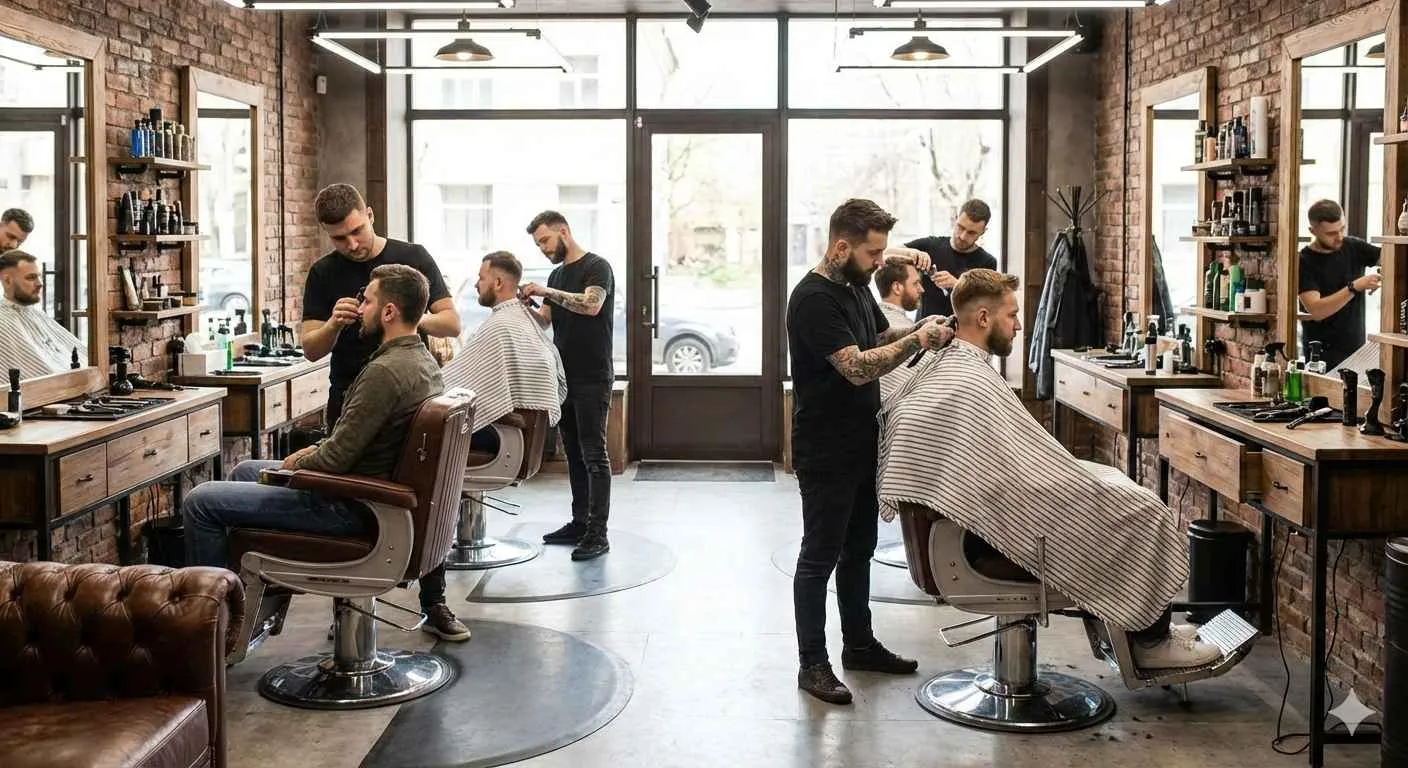
In 2026, if you aren't in the top 3 results of Google Maps, you're effectively invisible to nearby searchers — most people looking for a local barber never scroll past the map. Optimize your Google Business Profile with high-resolution photos of your shop's interior and team.
Google's algorithm now favors "completeness" and "recency" — profiles that are fully filled out and regularly updated outrank ones that were set up once and forgotten.
2. Automated Review Generation for a Barber Business
Don't wait for reviews to trickle in — engineer them. Tools like Happoin can automatically send a "thank you" WhatsApp message 24 hours after a cut, including a direct link to your Google review page.
A consistent stream of fresh 5-star reviews is one of the strongest local ranking factors, because Google treats review velocity as a signal of an active, trustworthy business.
3. Local Google Ads
Instead of broad advertising, use radius targeting. Set up Google Search Ads that only appear to people within a 5–10 mile radius of your shop.
Bid on keywords like "best beard trim near me" to capture high-intent traffic — potential clients searching at the exact moment they want to spend money, not just browsing.
Part 2: Which social media formats actually work for a barbershop?
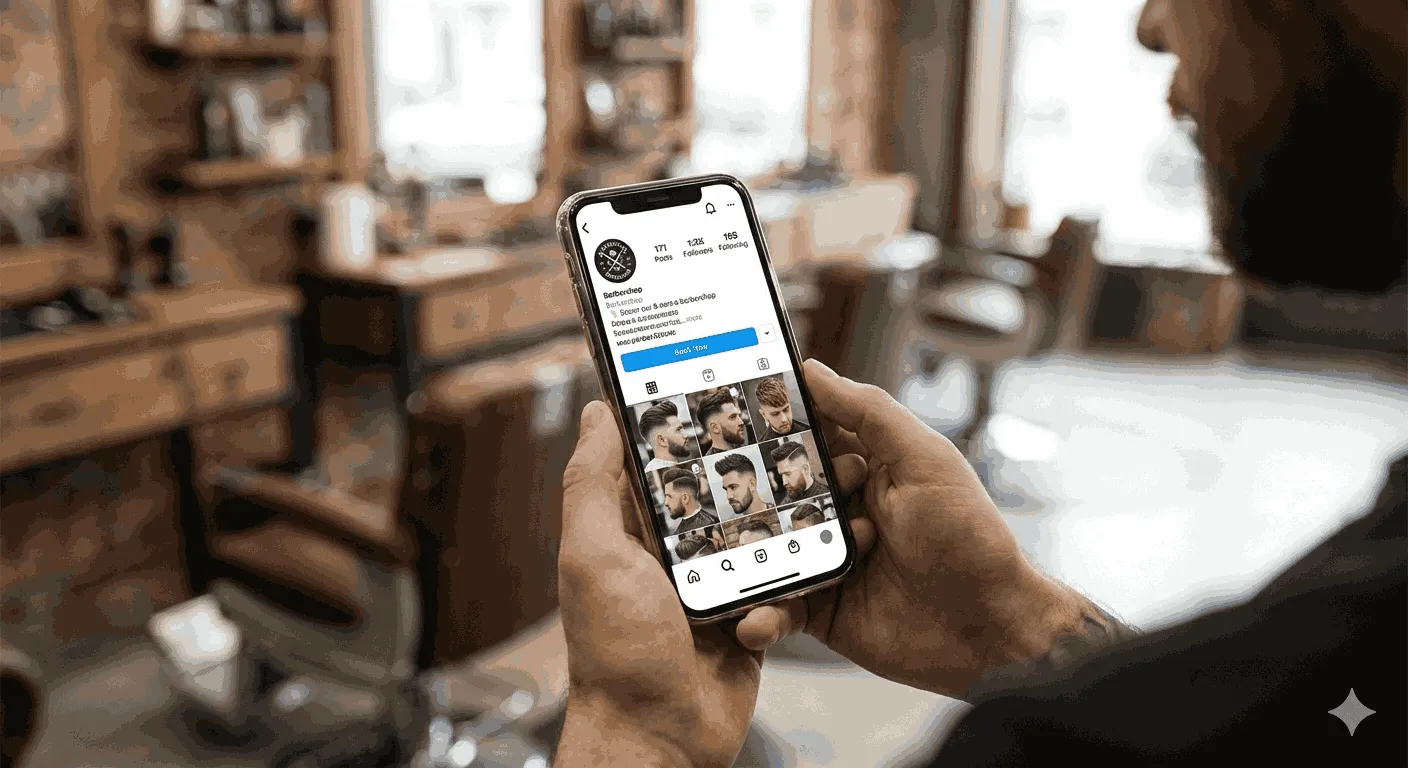
Short-form video, a frictionless booking link, and user-generated content outperform static photos for barbershop marketing. Content is the new currency for local businesses, and the shops that win move beyond basic before-and-afters into formats that capture the "vibe" of the shop itself. For a deeper breakdown of turning Instagram into a booking channel, see our hair salon Instagram marketing guide, which applies almost entirely to barbershops too.
A strong social media presence isn't about posting more — it's about giving people an honest preview of the client experience they'll get in your chair.
4. Short-Form Video (Reels)
Content is the new currency for local businesses and one of the most effective barbershop marketing strategies . To stand out, you need to move beyond basic photos and embrace video formats that capture the "vibe" of your shop. Focus on these three high-performing styles:
-
The Transformation: High-speed before-and-afters. Nothing proves your skill better than a "shaggy-to-sharp" transition.
-
The ASMR Experience (Sensory Marketing): ASMR stands for Autonomous Sensory Meridian Response. It refers to that relaxing "tingling" sensation people get from listening to specific sounds like crisp clipper clicks, the rhythmic snip of scissors, or the hiss of a hot towel steamer.
-
How to apply it: Instead of layering loud music over your video, use the high-quality natural audio of the haircut. Use a clip-on microphone to capture the "crunch" of the clippers or the scrape of a straight razor. These videos are highly "binge-worthy" and signal to potential clients that your shop is a place of precision and relaxation.
-
-
The Lifestyle & Vibe: Show the "unspoken" value of your shop—the curated playlist, the premium coffee station, or the banter between barbers. People don't just buy a haircut; they buy a 30-minute escape from their daily routine.
5. The "Frictionless" Link in Bio
Your social media efforts are wasted if the client has to DM you to book. Place a direct booking link in your Instagram Bio and TikTok profile. Every extra click or manual message required is a 20% drop in your conversion rate.
6. User-Generated Content (UGC)
Encourage your clients to post a selfie and tag your shop. Offer a small incentive, like a free styling product sample, for every story they share. This turns your clients into a mini-sales force.
Part 3: How do you turn WhatsApp conversations into booked appointments?
You turn conversations into revenue by making sure every message gets an instant, bookable response — day or night. Clients often look for a barber outside business hours, and the shop that replies first is usually the shop that gets the booking.
Email marketing and SMS marketing still have a place for newsletters, promotional emails, and slow-period offers, but neither is built for time-sensitive messages. A booking confirmation sent by email can sit unread for hours, while the same message on WhatsApp is usually seen within minutes.
7. 24/7 AI Receptionist (HappiBot)
An AI-powered WhatsApp assistant like HappiBot answers FAQs such as "how much for a haircut?" and books the appointment while you sleep.
This matters most for the late-evening and weekend searches that would otherwise go to whichever shop replies first the next morning.
8. Speed-to-Lead Automation
In the US and UK markets, the first shop to answer usually wins the client. Automating your initial WhatsApp response guarantees every inquiry gets an instant booking link.
Without this, a slow reply just pushes the client to message the next shop on Google.
9. Instant WhatsApp Bookings
Stop the "back and forth" texting. By integrating your booking system directly into WhatsApp, you allow clients to see your real-time availability and confirm a slot in a couple of minutes.
Part 4: How do you protect revenue and keep clients coming back?
You protect revenue by preventing no-shows before they happen and reactivating clients before they forget about you. Industry benchmarks put no-show rates at roughly 5–15% of appointments, and a single missed slot typically costs a shop $40–$80 in lost service revenue alone, according to SQUIRE's analysis of barbershop no-show costs.
10. Automated No-Show Protection
Implement WhatsApp reminders sent 24 hours and 2 hours before the appointment. WhatsApp messages are typically opened within minutes because they land in an app people already check constantly, unlike email — see our examples of WhatsApp reminders that reduce no-shows for ready-to-use templates.
Shops that also require a deposit at booking see no-show rates drop to roughly 3–5%, compared to 15–25% for shops that don't, per NoShowCost's 2026 salon and barbershop benchmark.
11. The "Missing You" Re-activation
Your database is a goldmine. Set up an automated campaign for any client who hasn't visited in 30 or 45 days. A simple, personal text: "Hey [Name], it's been a month! Ready to look sharp for the weekend?" can boost monthly revenue by 15% overnight.
12. Digital Referral Programs
Move beyond paper cards. Use a digital referral system: Give a client a $5 credit for every new friend they bring in. Digital credits tracked in your system ensure clients keep coming back to spend their "earnings."
Part 5: How do you maximize revenue from every chair?
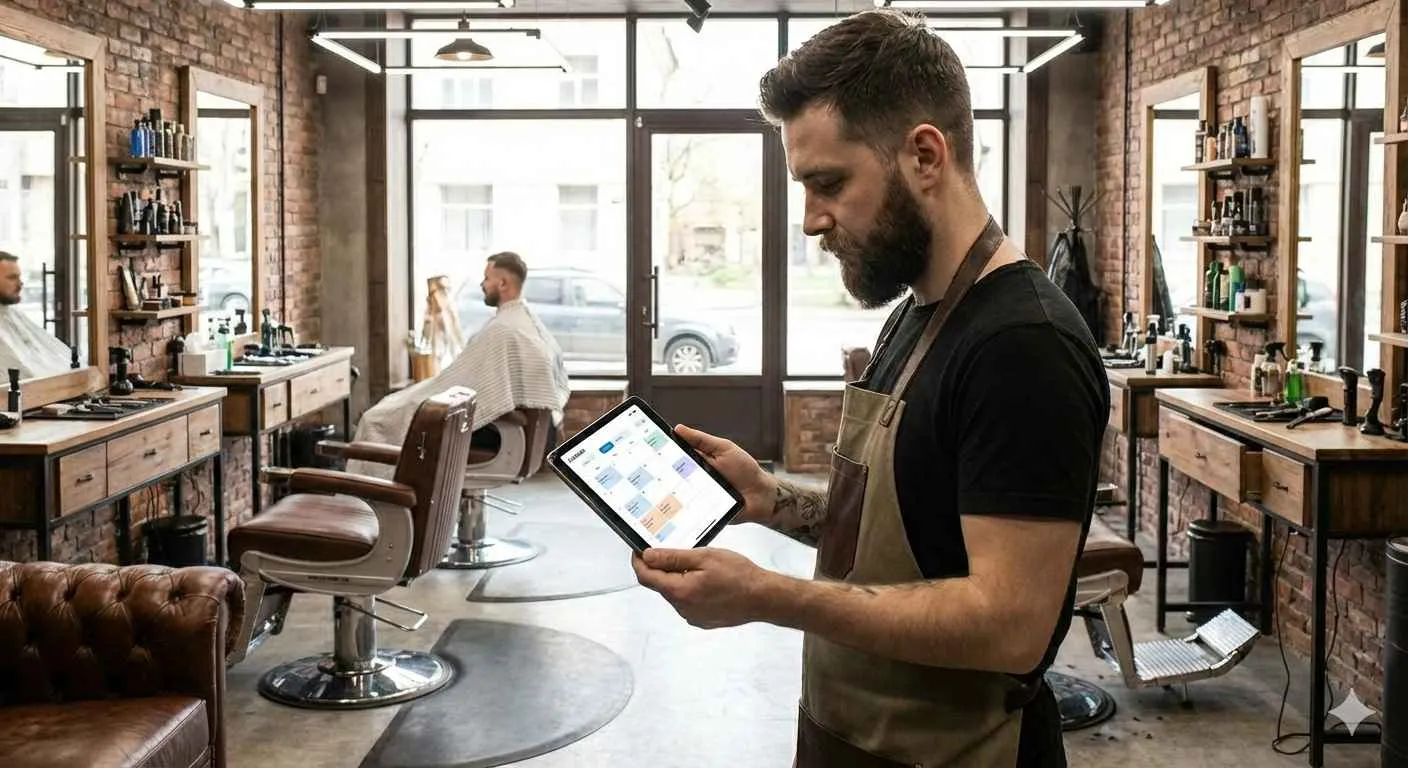
You maximize chair revenue by upselling at the point of service, filling dead hours with targeted promotions, and tracking performance by barber. These are the levers that turn a full schedule into a genuinely profitable one.
13. Upselling & Retail Integration
Your chair is a consulting station. Train your barbers to recommend specific products (pomades, oils, sprays) during the service. With Happoin, you can add these products to the final ticket with one click, increasing your Average Ticket Value (ATV).
14. Data-Driven Scheduling
Use your scheduling data to identify "dead zones" in your week — usually Tuesday mornings. Launch short "happy hour" promotions via WhatsApp specifically for those hours.
This ensures you're paying your barbers for active work instead of empty chairs.
15. Multi-Chair Performance Tracking
To grow past one chair, you need to know your numbers. Track which barber has the highest retention rate and who sells the most retail.
Rewarding top performers creates a culture of excellence that clients notice and respond to.
How does a tool like Happoin support these barbershop marketing strategies?
Happoin is a WhatsApp-based appointment and marketing assistant built for service businesses that live and die by their schedule — barbershops, salons, clinics, and studios. It's not the only way to run these strategies, but it's designed specifically to automate the ones that eat the most time: reminders, review requests, and rebooking.
The feature barbers notice first is that every automated message goes out from the shop's own WhatsApp number — the same number clients already have saved, not a generic short code they don't recognize. That single detail is why reply and confirmation rates tend to be higher than with anonymous SMS systems; see our breakdown of why sending reminders from your own number increases attendance for the full reasoning.
Across Happoin's client base of appointment-based businesses — including barbershops and salons — automated WhatsApp reminders have been linked to no-show reductions of up to 39% and time savings of around 49% on manual scheduling work, based on internal usage data. Results vary by shop size and client base, so treat these as directional rather than guaranteed.
-
HappiBot (the AI advantage): answers WhatsApp messages 24/7, including FAQs, and books appointments directly in the chat.
-
The no-show killer: automated WhatsApp reminders sent from your shop's own number, timed 24 hours and 2 hours before each appointment.
-
A professional booking link: a page where clients schedule and, if you choose, pay in advance.
-
Automated review requests: sent the moment a service is marked complete, to keep your Google Maps ranking climbing.
Happoin fits shops that already have a steady flow of repeat clients and want to stop losing time to manual reminders and rebooking — it's less suited to a brand-new shop with only a handful of weekly appointments, where the automation has less to work with yet.
How does Happoin compare to other ways of managing barbershop bookings?
The table below compares the three most common approaches barbershops use to manage bookings and reminders, focused on the factor that affects attendance the most: which number the client sees the message coming from.
|
Approach |
Reminders sent from |
Setup effort |
Typical no-show impact |
|---|---|---|---|
|
Manual calls / texts |
Barber's personal phone |
High (daily manual work) |
Inconsistent — depends on memory |
|
Generic booking apps / SMS |
Shared shortcode or unknown number |
Low |
Reduced, but lower open rates on unrecognized numbers |
|
Happoin |
The shop's own WhatsApp number |
Low |
Reduced further — clients recognize the sender |
Conclusion: how do you go from busy barber to scalable
Growth doesn't happen by accident — it happens when manual chaos gets replaced with automated systems. Dominate local search, create content that shows the vibe of your shop, and automate the conversations and reminders that protect your revenue.
If you want a starting point for the automation piece specifically, our guide to booking software for service businesses walks through what to look for beyond barbershops. Ready to test the WhatsApp side of this for your own shop? Start a free Happoin trial and see how your reminders and rebookings perform on your own number.
Ready to fill your chairs? Start your free Happoin trial today and automate your way to a full calendar.